
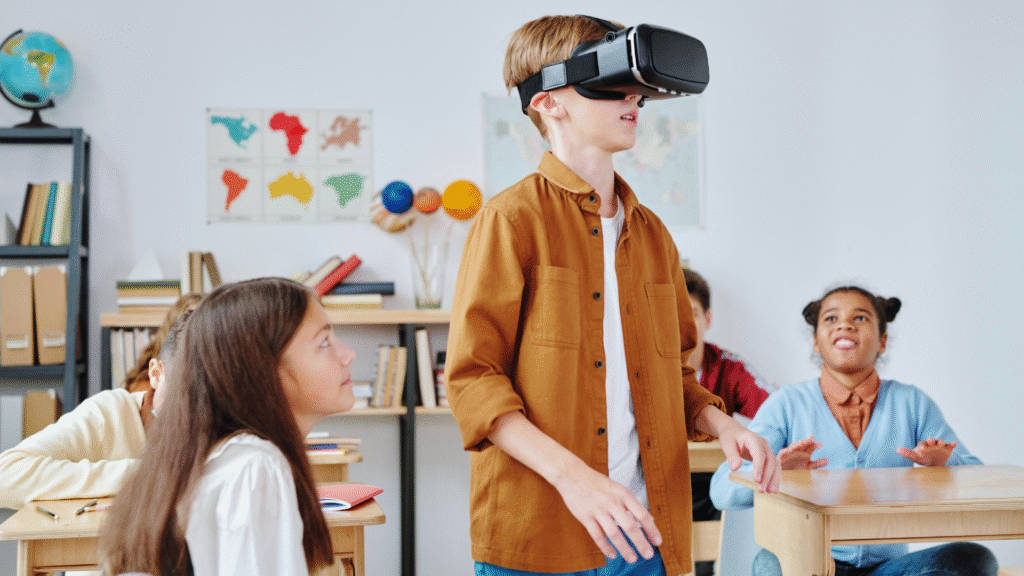
Virtual reality is transforming science education by providing interactive and immersive learning experiences that traditional methods cannot match. It allows students to explore complex scientific concepts and environments in ways that enhance understanding and engagement. The use of virtual reality in education makes abstract scientific ideas tangible and accessible.
This technology enables learners to conduct virtual experiments, explore microscopic worlds, or travel through space without leaving the classroom. By doing so, it addresses limitations of time, cost, and safety that often restrict hands-on science education.
As education evolves, virtual reality offers new opportunities to personalise learning and adapt experiences to individual needs. It supports deeper comprehension and stimulates curiosity, making science more approachable and effective for diverse learners.
The Role of Virtual Reality in Transforming Science Education
Virtual reality enhances science education by creating a deeper understanding through interactive and realistic experiences. It allows students to actively participate in learning and perform scientific tasks that would be difficult or impossible in traditional settings.
Immersive Virtual Environments and Active Learning
Immersive virtual reality environments enable students to explore complex scientific phenomena firsthand. Using VR headsets, learners can enter detailed virtual environments like molecular structures or ecosystems, promoting active learning. This hands-on involvement helps cement abstract concepts by placing students inside the science they study.
Active learning through VR reduces passive observation. Students manipulate elements, conduct virtual dissections, or navigate inside a cell, which encourages critical thinking and problem-solving skills. Schools equipped with VR hardware provide opportunities beyond what textbooks or videos offer.
Simulation and Experimentation in Scientific Concepts
Virtual reality simulations replicate real-world scientific experiments without safety risks or logistical limits. Students test hypotheses, adjust variables, and observe outcomes within highly controlled virtual settings. This flexibility supports better comprehension of difficult concepts such as chemical reactions or physics laws.
Simulations also allow repeated trials without material cost or waste. They enable visualisation of invisible or fast processes—like atomic interactions or planetary orbits—enhancing theoretical learning. By bridging theory and practice, VR simulations become a vital tool in science education.
Enhancing Student Engagement and Motivation
VR in education significantly improves student engagement by making lessons more interactive and stimulating. Immersive learning captivates interest, which increases motivation to explore scientific subjects deeply. The novelty of VR hardware and environments consistently draws students’ attention.
Engaged students are more likely to retain information and perform better academically. Virtual reality helps personalise learning pace and style, accommodating diverse needs. This tailored experience boosts confidence and fosters a sustained curiosity in science topics.
Innovative Applications of Virtual Reality Technology in the Science Classroom
Virtual reality technology enhances science education by creating immersive, engaging, and practical learning opportunities. It enables students to interact with complex scientific concepts and global issues through hands-on virtual environments and technology integration.
Interactive Learning Experiences and Gamification
Virtual reality creates immersive simulations where students can conduct experiments and explore scientific phenomena safely and repeatedly. This interactive learning improves comprehension of abstract concepts such as molecular structures or physics principles.
Gamification elements, like scoring systems and virtual challenges, motivate students to solve problems and engage in active learning. VR platforms often include instant feedback, helping learners adjust their strategies and deepen their understanding.
Teachers can customise VR modules to match curriculum goals, promoting personalised education. These interactive experiences also foster collaboration, as students often work in virtual teams to accomplish tasks.
Technology-Enhanced Sustainability and Climate Change Education
VR allows students to visualise the effects of climate change in real time, such as rising sea levels or deforestation impacts. This direct interaction with environmental scenarios cultivates awareness and critical thinking about sustainability.
Virtual reality can simulate ecosystems and global weather patterns, enabling learners to experiment with human impact variables. Students witness cause-and-effect relationships, leading to more informed discussions on environmental protection.
The immersive nature of VR technology encourages empathy by placing learners within vulnerable environments, increasing engagement with climate change science. This approach supports educational technology’s goal to make complex data accessible and meaningful.
Augmented Reality and Blended Educational Approaches
Augmented reality (AR) integrated with VR expands science teaching by overlaying digital content onto real-world contexts, enhancing the learning environment. AR apps often complement classroom lessons by visualising scientific models without the need for specialised equipment.
Blended approaches combine traditional teaching with VR and AR, providing flexible learning pathways. Students benefit from tactile activities alongside immersive simulations, reinforcing knowledge through multiple modalities.
Teachers can use AR for quick demonstrations and VR for in-depth exploration, creating a layered educational experience. This integration supports diverse learning styles and encourages continuous engagement with scientific content.
Opportunities and Challenges of Integrating Virtual Reality into Science Education
Virtual reality offers novel ways to enhance science learning but also presents practical and ethical complexities. Technology requirements, user experience, and ensuring equitable access pose major challenges for educators and institutions aiming to adopt VR.
Accessibility and Inclusivity in Learning Environments
VR learning experiences can bring abstract scientific concepts to life, benefiting diverse learners, including those with disabilities. However, high costs of VR hardware and limited internet connectivity restrict access, especially in underfunded schools.
Inclusive content design is crucial. Customisable simulations help accommodate varied learning styles and needs, but many platforms lack these features. Language options and adjustable difficulty levels also affect inclusivity.
Institutions must balance investment in VR with other educational priorities, ensuring technology does not widen existing achievement gaps. Training educators to use VR effectively is another vital step to improving accessibility.
VR Hardware, Haptic Feedback, and User Experience
Effective VR science education depends on reliable, comfortable hardware such as virtual reality goggles. Current devices vary in weight, resolution, and motion tracking, affecting user comfort and immersion.
Haptic feedback adds a tactile layer, enabling students to feel virtual objects or forces. This can deepen understanding but requires specialised equipment, often increasing costs and maintenance needs.
User experience issues like motion sickness, set-up complexity, and software glitches can hinder learning. Optimising VR environments to minimise these problems is essential for smooth technology-enhanced learning.
Ethical and Practical Considerations
Privacy is a key concern with VR platforms collecting biometric data. Institutions must implement strict data protection policies to safeguard students’ information.
There are questions about screen time limits and the psychological effects of extended VR use on young learners. A balance between virtual and hands-on experiences is necessary.
Practical issues include technical support demands and curriculum integration. Teachers need clear guidelines and resources to incorporate VR meaningfully without disrupting established learning outcomes.
The Future of Science Education with Virtual Reality
Virtual reality is set to reshape how university students interact with scientific concepts by tailoring experiences and transforming teaching methods. This shift combines emerging technologies with learning frameworks, aiming for deeper understanding and engagement.
Artificial Intelligence and Personalised Learning
Artificial intelligence enhances VR learning by adapting content to each student’s pace and style. With AI, virtual labs can adjust complexity based on individual performance, allowing learners to revisit challenging topics without pressure.
AI-driven analytics provide educators with detailed insights into student progress, helping to identify gaps in understanding early. This personalised approach is expected to increase retention and motivation, especially in large university settings with diverse skill levels.
Moreover, AI chatbots integrated within VR environments offer real-time feedback and assistance, mimicking a personalised tutor’s role. This continuous support ensures that students remain engaged and receive immediate clarification of complex scientific concepts.
Evolving Pedagogies and the Future of Technology Integration
VR is encouraging a shift from passive learning to immersive, active participation. Future pedagogies will focus on experiential learning, where students manipulate virtual molecules or navigate ecosystems, fostering hands-on understanding.
Technology integration will prioritise collaborative VR spaces, enabling students from different locations to work together in real-time. This will expand access to practical science education, especially where physical labs are limited.
Institutions increasingly embed VR modules into curricula to complement traditional methods. This blend of digital and face-to-face learning aims to enhance critical thinking and problem-solving skills relevant to scientific careers.