

Every time a student logs into a virtual learning environment, watches a lecture recording, submits a quiz, or posts on a discussion forum, they leave behind a trail of data. For years, this information sat largely unused in university servers. Today, however, a growing field known as learning analytics is transforming those digital footprints into powerful insights that can improve teaching, boost retention, and personalise education at scale.
Learning analytics has quietly become one of the most consequential developments in modern education. Institutions from the Open University to Arizona State have used it to identify struggling students weeks before they would otherwise have been noticed, to redesign courses that were not working, and to rethink what “student success” actually means. Yet for many educators, students, and parents, the term remains unfamiliar — or worse, sounds vaguely sinister.
This article explores what learning analytics is, how it works, why it matters, and what its rapid growth means for the future of education. Whether you are a lecturer, an administrator, a student, or simply curious about the role of learning analytics in modern education, this guide covers the essentials.
What Is Learning Analytics? A Clear Definition
At its simplest, learning analytics is the measurement, collection, analysis, and reporting of data about learners and their contexts, for the purposes of understanding and optimising learning and the environments in which it occurs. This definition, widely cited in academic literature and organisations such as the Society for Learning Analytics Research (SoLAR), captures the essential point: learning analytics is not merely about data, but about using data to improve educational outcomes.
It is worth distinguishing learning analytics from a few related concepts:
- Educational data mining focuses on developing computational methods to explore educational data — it is more technical and research-oriented.
- Academic analytics operates at the institutional level (enrolment trends, funding, graduation rates) rather than at the level of individual learners.
- Learning analytics sits between the two: it examines learner-level data to support teaching and learning decisions.
In practice, learning analytics draws on data from multiple sources: learning management systems (such as Moodle, Canvas, or Blackboard), library access records, attendance systems, assessment platforms, student information systems, and even lecture-capture viewing habits. When combined and analysed thoughtfully, these data sources can reveal patterns invisible to even the most experienced teacher.
How Does Learning Analytics Actually Work?
The process typically unfolds in four stages, often described as the learning analytics cycle.
1. Data Collection
Institutions gather data from the digital systems students already use. This includes:
- Login frequency and time spent on the learning platform
- Resources accessed (readings, videos, quizzes)
- Assessment submissions and grades
- Participation in discussion forums and group activities
- Library usage and, in some cases, campus attendance
2. Data Processing and Integration
Raw data from disparate systems must be cleaned, standardised, and integrated. This is often the most technically demanding step, as data may exist in different formats across platforms that were never designed to communicate with one another.
3. Analysis and Modelling
Analysts — often with the help of machine learning algorithms — identify patterns and build predictive models. For example, a model might learn that students who have not logged in for seven consecutive days, who scored below 50% on the first quiz, and who have not accessed the reading list are at high risk of failing or withdrawing.
4. Intervention and Feedback
Insights are delivered to the people who can act on them: students themselves (via dashboards), tutors (via alerts), and administrators (via reports). The crucial final step is closing the loop — checking whether interventions actually improved outcomes, and refining the models accordingly.
Why Learning Analytics Matters: Key Benefits
The growing adoption of learning analytics is not driven by technological enthusiasm alone. There are tangible, measurable benefits that explain why universities, schools, and corporate training providers are investing heavily in this field.
Early Identification of At-Risk Students
Perhaps the most celebrated application is early-warning systems. Research consistently shows that a significant proportion of student dropout is predictable. A study by the UK higher education body Jisc found that institutions using learning analytics reported improved retention rates and better-targeted support. Georgia State University in the United States, a frequently cited example, has used predictive analytics to dramatically reduce dropout rates — particularly among students from disadvantaged backgrounds — by triggering timely, personalised interventions.
The logic is straightforward: a tutor with 300 students cannot manually track everyone’s engagement. An analytics system can. When a student who was previously active suddenly goes quiet, the system flags it, and a support adviser can reach out before the student disengages entirely.

Personalised Learning at Scale
Traditional education often treats all students identically: same lectures, same readings, same assessments. Learning analytics enables adaptive learning, where content and pacing adjust to individual needs. Platforms such as Smart Sparrow and ALEKS use analytics to serve different questions, explanations, and resources to different students based on their demonstrated understanding — something a single teacher simply cannot do for a large class.
Improved Course Design
Analytics does not only benefit students; it also helps educators. By examining where students consistently struggle — a particular quiz question, a video they skip, a reading they never open — course designers can identify weak points and refine their materials. This turns course development from an act of intuition into an evidence-based process.
Enhanced Student Self-Awareness
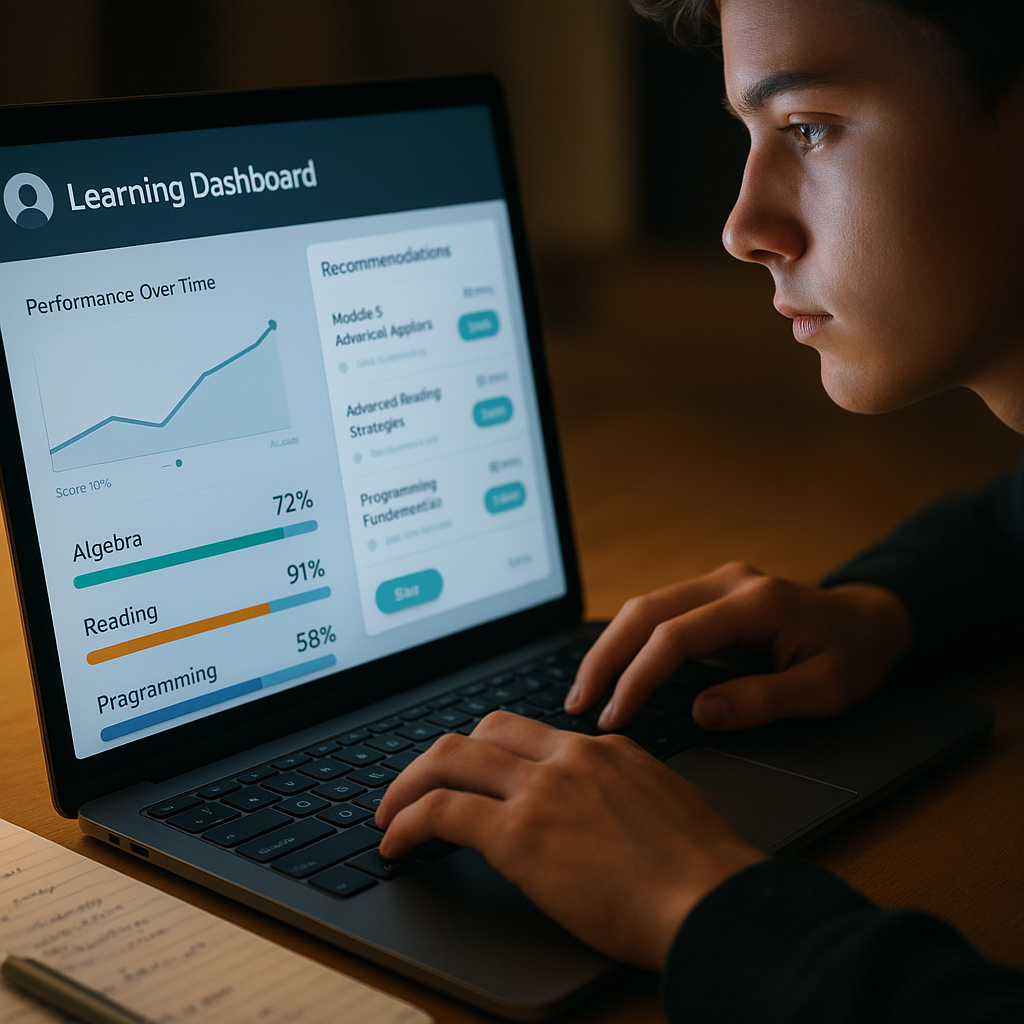
Many modern learning analytics dashboards are designed for students themselves. When learners can see their own engagement patterns compared (anonymously) with their peers, or visualise their progress towards learning objectives, they often adjust their behaviour. This is sometimes called the feedback effect — simply showing students their data can motivate change, much as a fitness tracker encourages people to walk more. Some institutions have also found that gamification boosts student engagement when combined with these feedback dashboards, turning progress tracking into an interactive experience.
Data-Informed Institutional Strategy
At a strategic level, learning analytics helps universities answer fundamental questions: Which courses have the highest failure rates, and why? Which teaching approaches correlate with better outcomes? Where should support resources be concentrated? In an era of tightening budgets and increasing accountability, such evidence is invaluable.
Real-World Examples of Learning Analytics in Action
To move beyond theory, it helps to look at how learning analytics is being applied across different educational contexts.
Higher Education
The Open University in the UK has been a pioneer, developing its own analytics systems to track distance learners and identify those at risk of module failure. Their approach emphasises actionable alerts for tutors rather than automated judgements about students.
Purdue University created Course Signals, one of the earliest widely discussed early-warning systems. It analysed student data to generate a traffic-light indicator (green, amber, red) for each student, prompting instructors to intervene with at-risk learners. Reported results included significant improvements in retention.
Schools (Primary and Secondary)
Whilst learning analytics is most developed in higher education, schools are increasingly adopting similar approaches. Platforms used in UK schools now track pupil progress across subjects, flag gaps in understanding, and help teachers differentiate instruction. The key difference is that in schools, the ethical stakes around consent and data protection are even higher, given that the learners are minors.
Corporate and Professional Learning
Beyond formal education, organisations use learning analytics to evaluate training programmes, measure skill development, and link learning activity to performance outcomes. This is particularly relevant in sectors requiring continuous professional development, such as healthcare, finance, and technology.
The Role of Learning Analytics in Modern Education
Zooming out, learning analytics is reshaping education in at least three fundamental ways.
First, it is shifting education from reactive to proactive. Traditionally, support arrived after failure — a failed exam, a missed deadline, a withdrawal form. Analytics enables institutions to intervene before failure occurs, which is both more effective and more humane.
Second, it is challenging the “average student” assumption. For decades, courses were designed around a hypothetical average learner. Analytics reveals the enormous diversity of learning patterns — students who binge-study versus those who work steadily, those who learn best from video versus text, those who participate actively versus those who learn quietly. Recognising this diversity is the first step towards accommodating it.
Third, it is making education more accountable. When institutions can measure what works, claims about teaching quality can be tested rather than merely asserted. This has implications for everything from course approval to national education policy.
That said, learning analytics is not a silver bullet. Data can tell you that a student has stopped logging in, but not why. Perhaps they are ill, working extra shifts, dealing with family difficulties, or simply bored. The most effective implementations combine quantitative analytics with qualitative human judgement — the data prompts a conversation, but a person has that conversation.
Challenges and Ethical Considerations
No discussion of learning analytics is complete without addressing its risks and limitations.
Privacy and Consent
Collecting detailed data about student behaviour raises legitimate privacy concerns. Do students know what data is being collected and how it is used? Can they opt out? In the UK, data protection legislation (including UK GDPR) provides a legal framework, but ethical practice goes beyond legal compliance. Leading institutions publish clear learning analytics policies and involve students in governance decisions.
Data Quality and Interpretation
Poor data leads to poor decisions. If a learning management system inaccurately records activity, or if engagement data does not actually correlate with learning (a student might have the textbook open on their desk without ever logging in), analytics can be misleading. Over-reliance on proxy measures — clicks, logins, time-on-page — risks confusing activity with understanding.
Equity and Bias
Predictive models are only as fair as the data they are trained on. If historical data reflects existing inequalities — for instance, if students from certain backgrounds were historically more likely to drop out — a naive algorithm might perpetuate those patterns by treating demographic characteristics as predictors of failure. Responsible learning analytics requires careful attention to bias, transparency about how models work, and a commitment to using data to close gaps rather than reinforce them.
The Risk of Reductionism
Education is about more than measurable outcomes. Critical thinking, creativity, intellectual curiosity, and personal growth do not easily reduce to dashboard metrics. There is a real danger that institutions optimise for what is measurable at the expense of what is valuable. Learning analytics should inform educational judgement, not replace it.
Current Trends and Future Directions
The field is evolving rapidly. Several trends are worth watching:
- Integration with artificial intelligence: Large language models and advanced machine learning are enabling more sophisticated analysis, including natural language processing of student writing and discussion posts.
- Multimodal analytics: Researchers are exploring data beyond clicks and grades — including audio, video, and even biometric data in laboratory settings — to understand learning more holistically. This raises additional ethical questions but promises richer insights.
- Student-facing analytics: There is a growing emphasis on giving learners control over their own data, empowering them to set goals and monitor progress rather than simply being monitored by institutions.
- Cross-institutional standards: Efforts such as the Caliper Analytics standard and xAPI (Experience API) are making it easier to share and compare data across platforms and institutions, enabling larger-scale research.
- Analytics for wellbeing: Some institutions are exploring whether engagement data can help identify students experiencing mental health difficulties, enabling earlier pastoral support — though this application is particularly sensitive and contested.
The global learning analytics market reflects this momentum. Analysts project continued double-digit growth, driven by the expansion of online and blended learning environments, increasing availability of educational data, and rising pressure on institutions to demonstrate effectiveness. Universities are also responding by offering dedicated learning analytics courses and postgraduate programmes, training the next generation of educational data specialists.
Getting Started: Practical Advice for Educators
If you are an educator interested in using learning analytics, the prospect can feel overwhelming. Here are some pragmatic starting points:
- Start small: You do not need a sophisticated predictive model. Begin by examining the analytics already built into your learning management system — most platforms provide basic reports on access, engagement, and completion.
- Focus on questions, not data: Rather than collecting data for its own sake, start with a specific question: “Which resources do my students actually use?” or “At what point in the module do students disengage?” Let the question drive the analysis.
- Talk to your students: Data tells you what is happening; students can tell you why. Combine analytics with conversations, surveys, and focus groups for a fuller picture.
- Respect privacy: Be transparent with students about what data you are using and why. Ensure your practice complies with institutional policies and data protection law.
- Iterate: Treat analytics as an ongoing cycle of inquiry, not a one-off project. Act on insights, measure the impact, and refine your approach.
Conclusion
Learning analytics is no longer a niche academic interest or a futuristic aspiration. It is an increasingly central part of how modern educational institutions operate — from identifying at-risk students and personalising learning pathways to improving course design and informing institutional strategy. The data that students generate through their everyday interactions with digital learning environments, when analysed thoughtfully and ethically, offers genuine opportunities to make education more responsive, inclusive, and effective.
At the same time, the field carries real risks. Privacy concerns, algorithmic bias, data quality issues, and the danger of reducing education to mere metrics are challenges that require ongoing vigilance. The most successful implementations of learning analytics are those that keep human judgement, empathy, and educational values at the centre — using data as a tool to support better decisions, not as a substitute for making them.
As technology continues to evolve and educational data becomes ever richer, learning analytics will only grow in importance. The institutions, educators, and policymakers who engage with it thoughtfully — embracing its potential whilst honestly confronting its limitations — will be best placed to shape an educational future that genuinely serves all learners.